


66% of French people consider the National Assembly to be failing: shock findings from the 9th wave of the Observatoire Parlement
The results of the ninth wave of the Observatoire Parlement, a barometric study conducted by Toluna Harris Interactive for Séance Publique and HEIP, were presented on Thursday June 4 at the Salon des affaires publiques et de l’influence, in the presence of :
- Jean-Daniel Lévy, Managing Director, Toluna France
- Ludivine Philippon, Executive President of Séance Publique
- Richard Amalvy, HEIP Academic Director
- Benjamin Morel, Professor at HEIP
With one year to go before the presidential election and the end of Emmanuel Macron’s second term in office, this ninth wave provides a mixed assessment of parliamentary life since 2022. For the ninth consecutive time since the Observatoire was launched in September 2022, HEIP has joined forces with Séance Publique and Toluna Harris Interactive to partner this benchmark study of the French people’s relationship with their Parliament. As with every wave, many of our students came to find out first-hand the results, which are always a rich source of information on the relationship between the French and their Parliament.
Conducted online from May 12 to 15, 2026 among 1,007 people representative of the French aged 18 and over, the survey reveals persistent mistrust of institutions, tempered by a few signs of recovery.
Understanding these dynamics is at the heart of our teaching. Analyzing the perception of institutions and the balance of political power are key skills that we pass on to our future public affairs experts.
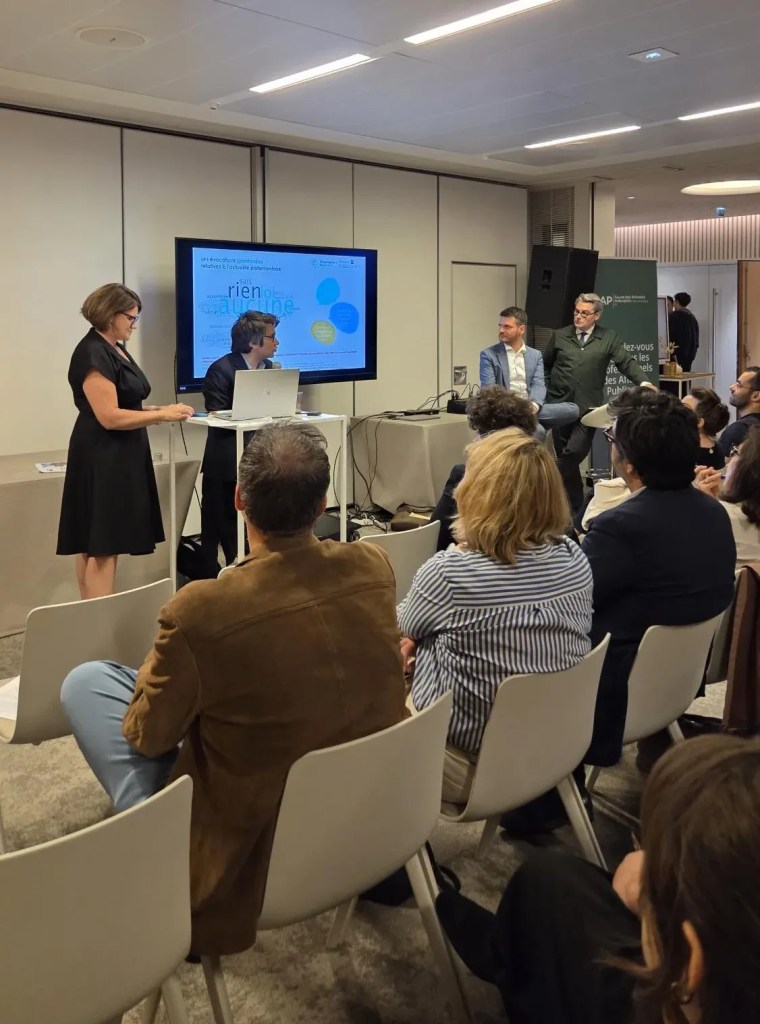
Plenary conference at the Salon des Affaires Publiques et de l’Influence.
From left to right: Ludivine Philippon (Séance Publique), Jean-Daniel Lévy (Toluna Harris Interactive), Richard Amalvy (HEIP) and Benjamin Morel (HEIP).
A fragile confidence boost
After a low point measured in October 2025, in the midst of governmental instability, confidence in the ability of institutions to make a real difference to the lives of French people has risen slightly. Local authorities remain the most trusted level (61%), ahead of the National Assembly (58%), the President of the Republic (57%) and the Prime Minister (52%).
The highlight of this wave is the repositioning of the Senate, which rises 7 points to 49% approval. The upper house enjoys a generally positive image:
- 65% of French people see it as a counterweight to the National Assembly
- 64% believe it improves the quality of legislative texts
- A majority see it as a place for calm debate (60%) and serious work (54%).
A notable limitation is that only 43% of French people consider the Senate to be representative of French society, a figure that has remained stable over the past three years. Furthermore, 59% do not want the presidential camp to win a majority in the Senate in the September elections.
Commissions of inquiry: useful but suspected of being exploitative
Against a backdrop of intense media coverage of the commission on public broadcasting, the French recognize the usefulness of these bodies: 67% believe they serve to make recommendations and publicize malfunctions, and 62% to monitor government action.
But this legitimacy is nuanced: 58% of those surveyed consider that they also serve the personal communication of elected representatives, and only 43% feel that they have too much power.
This duality between public utility and communication strategy is a textbook case for our MSc Political, Institutional Communication & Lobbying students, who learn to decipher the behind-the-scenes workings of legislative power.
Persistent mistrust of parliamentary groups

No parliamentary group satisfies a majority of French people. The Rassemblement National remains the best-rated formation with 43% positive opinions, ahead of LR/Droite Républicaine (35%, +3 points), Horizons (32%, +4) and the Écologistes (31%, +4). Renaissance stagnates at 27%, with MoDem at 23%.
This almost across-the-board increase compared to autumn 2025 – when most formations had reached their lowest level – should be read with caution: it reflects more a rebound from an all-time low than a return to confidence. The RN is still perceived as the main opposition force to the government (40%), far ahead of the Insoumis (26%) and the Socialists (10%).
A harsh assessment of the legislature
This is undoubtedly the most striking finding of this survey. Whereas in 2022, 71% of French people saw the relative majority as an opportunity for dialogue, today 52% see it as a source of deadlock. The judgment of the National Assembly is harsh: 66% feel that it has not fulfilled its legislative mission well since 2022, and 61% that it has failed in its role of controlling the government. No political group considers that the lower house has performed its role of debating and voting on legislation well.
The study also highlights an a posteriori rereading of recent political crises: whereas 53% of French people approved of the censure of the Barnier government (December 2024) and 68% wanted François Bayrou to leave (September 2025), today 54% consider these episodes destabilizing for the political system. A significant turnaround shared by Ensemble (65%), LR (59%), RN (55%) and PS (52%) supporters.
Towards the institutionalization of power sharing?
In projection, the French seem to want to perpetuate a balance of power rather than return to absolute domination. In the event of new legislative elections :
- Only 14% would like an absolute majority for Renaissance and its allies
- 28% would prefer a relative majority
- 55% are in favor of cohabitation, an aspiration shared by all opposition supporters and a growing proportion of those close to the presidential majority.
Anchor your future in today’s corporate world: these issues are at the heart of our training programs of excellence. Discover how our programs prepare you to decipher and influence tomorrow’s world:
- MSc Political and Institutional Communication & Lobbying
- MSc Public Management & Public Policy
- MSc Geopolitics, Security & Defense
──────────────────────────────────────────────────
Observatoire Parlement, Wave 9. Toluna Harris Interactive survey for Séance Publique and HEIP, conducted online from May 12 to 15, 2026, among a sample of 1,007 people representative of the French aged 18 and over.
Last update on