


BECOME AGLOBAL LEADERIN INTERNATIONAL AFFAIRS AND DIPLOMACY
The globalized economy and current geopolitical upheavals demand professionals capable of navigating complex intercultural environments. In the face of new power dynamics, cross-border crises, and global challenges, possessing a sharp strategic vision is now essential.HEIP’s MSc in International Relations & Cooperation gives you the tools to understand and take action on the global stage.
Taught entirely in English at our Paris campus, this prestigious master’s-level program (RNCP Level 7 – No. 39853) is designed for students seeking a career with a strong international focus.
Starting in your first year (MSc 1), you will be fully immersed in both the language and the academic environment as you master the fundamentals of strategic intelligence, comparative foreign policy, political science, and international law.
The second year (MSc 2) is dedicated to advanced expertise, with an exclusive focus on our specialization in International Affairs & Economic Diplomacy. This unique program is designed to make you a key player in strategic development, multilateral negotiations, and the management of geopolitical risks.
Is this training program recognized by the government?
- Yes. This program leads to a Level 7 State Certification, NSF codes 128 & 346, “Expert in International Relations and Cooperation, ” registered under No . 39853 in the RNCP by decision of France Compétences dated November 28, 2024.
- Each completed year of study is worth 60 ECTS (European Credit Transfer System) credits, which are recognized throughout the European Higher Education Area. This system facilitates the international recognition of your degree and makes your academic background easier for European recruiters to understand.
- In addition to this academic recognition, the program culminates in the award of HEIP’s institutional certificate, the “MSc Expert in International Relations & Cooperation.” This degree crowns a high level of expertise acquired through interaction with world-renowned faculty and through innovative teaching methods focused on diplomatic practice.

What courses are offered in the MSc in International Relations and Cooperation?
This program is structured around four RNCP competency blocks, covering international relations, strategic analysis, project management, and crisis management. The program incorporates innovative teaching methods, including case studies, simulations, practical projects, seminars, and group work.
FIRST YEAR (MSc1)
406 hours
Module 1 — Fundamentals of International Relations & Legal Framework
Develop a thorough understanding of global legal standards, political thought, and the mechanisms that shape modern diplomacy.
- Comparative International Law: Contemporary Issues
- Advanced IR Theories: Neoliberalism, Constructivism, and the Critical School
- European Union Foreign Policy
- Non-State Actors: Corporations, NGOs, and Terrorist Organizations
- Global Challenges: Migration, Climate Change, and Inequality
- Conflict, Peace, and Post-Conflict Reconstruction
Division 2 — Strategic Intelligence, Project Management, and Communication
Develop practical expertise in foresight, data analysis methodologies, and communication techniques in an intercultural context.
- Strategic Intelligence and Foresight Analysis (Digital Tools)
- Comparative Foreign Policy Analysis (Quantitative Approaches)
- Advanced Research Seminar (Epistemology and Mixed Methods)
- Research Questions in Political Science
- Advanced Academic and Professional Writing in English
- Seminar: Media, Public Opinion, and Foreign Policy
Division 3 – Simulation & Forecasting
Apply one’s knowledge in real-world situations, scenario simulations, and group projects that address concrete global challenges.
- Simulation Workshop: UN Security Council
- Geopolitical Foresight — Scenarios for 2030 and 2050
- Interdisciplinary Group Project (Commissioned Real-World Case)
- Elective: Asia-Pacific / Africa / The Americas (Choose 1)
- Research or Professional Internship (5 Months)
SECOND YEAR (MSc 2)
406 hours
Division 1 — Geopolitics, Intelligence, Strategic Analysis
Refine one’s ability to analyze geopolitical shifts, anticipate emerging risks, and produce strategic assessments for decision-makers.
- Great Power Geopolitics: A Systemic Approach
- Global Disorder and the Reconfiguration of the Liberal International Order
- Elections, Democracies, and the Rise of Authoritarianism Around the World
- IR and Emerging Technologies: AI, Space, and Biotechnology in Global Competition
- Geospatial Data and Strategic Cartography
- Foresight and Scenario Planning: Advanced Methods (Delphi, RAND)
- Guest Lectures by Practitioners: Contemporary Issues
Division 2 — International Cooperation, Influence, and Crisis Management
Gain an understanding of political risk consulting methods, crisis response strategies, and the analysis of European foreign policies through the study of practical case studies.
- International Crises and Contemporary Conflict Management
- French and European Foreign Policy: Case Studies
- Geopolitics Clinic: Political Risk Consulting
- Leadership, Ethics, and Professional Responsibility
- Specialized Elective: Transatlantic Relations / Indo-Pacific (Choose 1)
Division 3 – Applied Expertise and Career Integration
Complete your specialization through applied research, the preparation of high-level analytical reports, and professional immersion within leading organizations.
- Capstone Project: Commissioned Geopolitical Analysis
- Academic Publishing or Analytical Report Writing Workshop
- Thesis Supervision Seminar (Research and Methodology)
- Master’s Thesis (Professional or Research Track)
- Final Internship (6 Months) at a Think Tank, Institution, Government Agency, or International Organization
Analysis, Action, and Excellence: High-Quality Education in the Service of International Relations
Objectives and Core Competencies
TheMSc in International Relations & Cooperationtrains experts capable of contributing across the entire diplomatic and strategic decision-making process. By the end of the program, you will have acquired the practical expertise to:
The training program is designed to help participants develop four key skills:
- Conducting strategic and economic intelligence assessments: mastering tools for market intelligence, geopolitical analysis, and country risk assessment to inform organizational decision-making.
- Develop and implement an international cooperation policy: draft cooperation agreements, secure funding, and coordinate international public-private partnerships.
- Managing international projects: planning, coordinating, and evaluating projects in a multicultural context, in collaboration with national and international stakeholders.
- Provide consulting services in crisis situations: analyze crises, coordinate the institutional response, and manage communications in unstable environments.
The 4 competency areas certified under the RNCP designation
The “Expert in International Relations and Cooperation” certification was registered with France Compétences in 2024 to meet the growing needs of international organizations, public institutions, and companies operating internationally. It is structured around four core modules:
Module 1 – Conducting a strategic and economic intelligence assessment of international issues
- Develop a comprehensive approach to strategic and economic monitoring to take into account all data that could influence the situation at hand
- Organize the research and implementation of the monitoring process by identifying key areas, appropriate tools (including AI), and sources to be utilized
- Ensure the security of data collection by using techniques specific to the chosen methodology and complying with the GDPR
- Analyze the collected data to identify opportunities and explore new avenues for growth
- Assess the situation in a country or region, identify the key players involved, and outline the key issues by evaluating the strategies of governmental and non-governmental actors
- Mapping country risks by cross-referencing data to identify key areas of focus
- Summarize and prioritize data in order to present the results of the market intelligence analysis with well-supported arguments
- Make critical recommendations to facilitate decision-making
Assessment: Written assignment and oral professional scenario
Module 2 – Developing and implementing an international cooperation policy
- Draft a cooperation agreement that takes into account the needs and interests of the represented organization and its partners
- Organize international meetings (ministerial meetings, interviews, site visits) and press releases
- Supporting the international development strategy of an international organization, an NGO, or a company
- Determining the most appropriate legal structure for an organization’s international expansion
- Organize project financing by leveraging all available tools (bank financing, concessional financing, European funding, multilateral funding, and development aid)
- Propose and coordinate international partnerships in various forms, including public-private partnerships
Assessment: Case Study
Block 3 – Managing an International Project
- Define and position the project within the internal organization to ensure its operational management
- Define the implementation schedule using monitoring tools and project management and international marketing techniques
- Mobilize a targeted network of national and international stakeholders based on their roles and expertise
- Organize the project management at each stage, taking into account cultural differences as well as societal and environmental issues
- Establish communication channels among multicultural teams to bring their members together
- Identify discrepancies from expected results and propose adjustments and corrective actions
- Propose lobbying initiatives based on corporate communications and foreign policy analysis
Assessment: Professional simulation with a written report and oral defense
Module 4 – Providing advisory and support services in international crisis situations
- Analyze crises to map their domestic, regional, and international consequences, taking into account their physical, cognitive, and informational dimensions
- Propose a crisis prevention policy based on the identification of key actors, destabilizing factors, and moderating forces
- Identify the appropriate communication tools to disseminate relevant information to the target audience
- Develop a crisis communication plan to prevent the distortion of facts and counter misinformation
- Advocate for a national and/or international crisis management plan to ensure the organization’s resilience
- Establish crisis management procedures that are consistent with national or international public plans
- Organize and lead a crisis response team by bringing together the right people and defining each person’s responsibilities
- Evaluate responses to a crisis and propose processes for improving and updating response plans
Assessment: Case Study
A hands-on immersion in the heart of global diplomatic issues
HEIP’s curriculum is developed in collaboration with researchers and practicing professionals, whose contributions are continually updated to anticipate changes in the international landscape and meet the practical needs of employers.
This dual expertise is directly reflected in the classroom: each course exposes students to real-world situations through geopolitical case studies, negotiation simulations, commissioned group projects, and seminars led by decision-makers from government ministries, intergovernmental organizations, think tanks, and international divisions of the private sector.
Assessment criteria: analyze, decide, persuade
Courses are assessed through continuous evaluation, using methods that directly reflect real-world professional situations:
- Case studiesdrawn from real-world diplomatic or strategic contexts
- Assessedworkplace scenariosfocusing on decision-making and adaptability
- Written papers followed by an oral defense before a panel
- A project report accompanied by an oral presentation (alternating track) or an oral presentation and a research thesis (initial track)
Career Opportunities: Join the decision-making centers of the global stage
The MSc in International Relations & Cooperation serves as a true springboard to the environments where the future of diplomacy and strategy is shaped. This program prepares our graduates to join leading organizations, both public and private, by equipping them with the skills needed to immediately take on high-level positions.
Flexible curriculum: choose the format that best suits your goals
To perfectly align with your career goals, this program has been designed to offer maximum flexibility. Depending on your background and opportunities, you can choose to complete the program as a traditional student or opt for an immediate immersion in the workplace through an apprenticeship.
Your academic program can therefore be structured in several ways:
- 1 year of full-time study followed by 1 year of work-study (first year full-time, second year work-study)
- 2 years of graduate study (M1 and M2)
- 2-year work-study program (Master’s 1 and Master’s 2)
- 1-year work-study program (Master’s 2) if applying after completing a four-year degree
- 1 year of initial training (M2) if applying after completing a four-year degree.
Whether you are an intern or enrolled in a vocational training or apprenticeship program, you are required by law to be paid (under French law).
The student program: one academic semester followed by an extended internship
- Academic structure: The program consists of a single intensive semester of 6 months of classes.
- Requirements: To complete the program, students must complete an internship of at least 110 days. This practical experience takes place within government agencies, NGOs, research firms, or international organizations.
- Financial Investment: Tuition is set at €10,350 per year. This amount is the student’s responsibility, and students can rely on various sources of funding (student loans, financial aid, internship stipends, or personal funds).
The apprenticeship path: immediate entry into the workforce
- Shared schedule: The student enters into a two-year contract structured around a regular schedule: one week on campus followed by two weeks at their employer’s facility.
- On-the-job training: Trainees spend at least 110 days per year at a company or institution. This program allows them to take on increasingly strategic assignments and gain greater independence over time.
- Cost Coverage and Compensation: The annual cost of the training program (€10,950) is fully covered by the host organization and its OPCO. Students therefore benefit from 100% tuition-free education while receiving a monthly salary for their work at the company.
CVEC fee must be paid before the start of the school year. Rates are valid for the 2026–2027 school year and are subject to annual review.
Tuition and Financial Aid Programs
| 2026–2027 | Initial training | Work-study program |
| Contract type | Internship | Vocational Training Contract or Apprenticeship Contract |
| Rhythm | 1 semester of coursework / 1 semester of internship | 2 weeks of work experience / 1 week of classes |
| Tuition | €10,350 per year | €10,950 per year |
| Funding | Personal savings, bank loans, CPF, private scholarships | OPCO and Company/Institution |
Application fee: €80 (regardless of the academic year for which you are applying)
CVEC fee must be paid before the start of the school year.
These rates are valid for the 2026/2027 school year and are subject to annual review.
Key Information and Campus Life
Who are our teachers?
A faculty composed of experts and practitioners The teaching team includes associate professors as well as high-level professionals. Each instructor holds at least a master’s degree and draws on solid practical experience gained in strategic sectors such as diplomacy, intelligence, defense, and global organizations.
Learn more about our faculty.

Where are our campuses located?
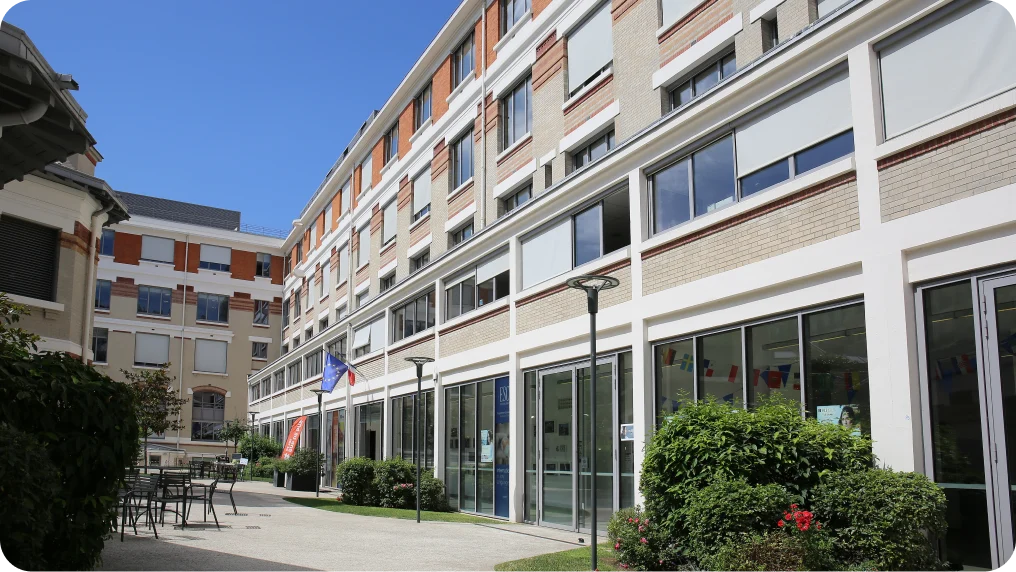
An immersive experience in Paris at the heart of decision-making bodies This MScin International Relations & Cooperation(taught entirely in English) is offered exclusively at our Paris campus. This prime location allows students and work-study students to develop their careers in close proximity to the major centers of French administrative and political power, a major asset for building their professional network.
Are the facilities accessible to people with disabilities?
Accessibility and Support for People with Disabilities All of our Paris facilities are fully equipped to accommodate visitors with limited mobility. We also ensure the inclusion of all applicants starting from the admissions phase:
- The selection tests may be conducted entirely online for individuals with physical disabilities.
- Our teams implement customized accommodations to support candidates with invisible or cognitive disabilities.
Your primary contact (Paris Campus): Farida Cherkaoui, Disability Coordinator (Email).

Last update on